
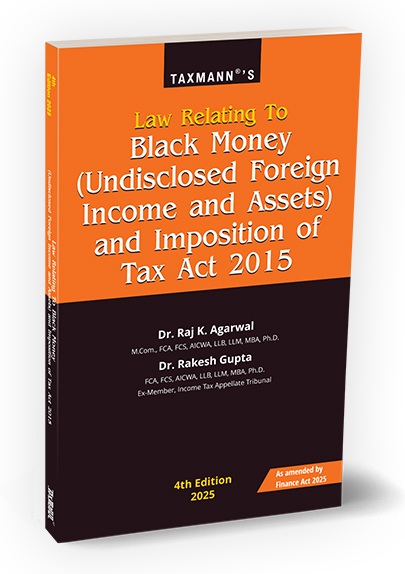
Description
This book provides a comprehensive and updated analysis of India’s legal framework to tackle undisclosed foreign income and assets. This Act—popularly called the Black Money Act—mandates disclosure requirements, confers assessment powers and prescribes stringent penal and prosecution provisions. This Edition discusses crucial areas such as the scope of chargeability, assessment and reassessment procedures, penalties for non-disclosure, and prosecution for evasion. Given the evolving nature of black money legislation and limited judicial precedents, the book is a critical guide for clarifying uncertainties and interpreting grey areas of the law.
This book is intended for the following audience:
- Chartered Accountants & Tax Practitioners – Offers detailed insights into the procedures for assessment, penalties, prosecution, and the interplay with the Income-tax Act, 1961, enabling practitioners to advise clients more accurately
- Advocates & Corporate Lawyers – Provides clarity on legal nuances, prosecution risks, and procedural safeguards essential for legal counsel and litigation strategy
- Finance and Compliance Professionals – Highlights the compliance obligations for resident Indians holding foreign assets or earning foreign income and addresses potential issues when converting from Non-Resident to Resident/Ordinarily Resident
- Academicians & Researchers – Supplies extensive references, illustrative case scenarios, and critical commentary on statutory provisions—valuable for academic research and teaching
- Business Owners & High Net Worth Individuals (HNWIs) – Explains obligations, risks, and best practices to avoid penalties under the Black Money Act, particularly if holding or planning investments abroad
The Present Publication is the 4th Edition | 2025 and has been amended by the Finance Act 2025. This book is authored by Dr Raj K. Agarwal & Dr Rakesh Gupta, with the following noteworthy features:
- [Latest Amendments] Incorporates all legislative changes introduced by the Finance Act 2025 to ensure readers have the most current legal positions and tax rates
- [Critical Analysis of Core Provisions] Each chapter offers an in-depth look at the scope and applicability of the Black Money Act, including charge, valuation, assessment, penalty, prosecution, and appeal mechanisms
- [Expert Commentary] Authored by two eminent professionals with decades of experience in direct taxes and representation before High Courts and the Supreme Court.
- [Practical Insights & Litigation Issues] Discusses emerging areas of litigation, interpretational dilemmas, and practical scenarios that practitioners and taxpayers commonly face
- [Extensive Referencing] Features relevant Circulars, Notifications, Rules, and forms, alongside cross-references to related provisions of the Income-tax Act 1961 and other key legislations
- [Valuation Rules] A dedicated section on valuation of foreign assets under the Black Money Act, clarifying the methodology for computing fair market value and addressing complex asset structures
The coverage of the book is as follows:
- Legislative Background & Intent
- Historical context behind the enactment of the Black Money Act
- Statement of Objects & Reasons; Rationale for a separate legislation distinct from the Income-tax Act, 1961
- Scope & Applicability
- Obligations for Resident Indians, particularly those transitioning from Non-Resident to Ordinarily Resident status
- Analysis of undisclosed foreign assets and income, including bank accounts, financial interests, and immovable properties
- Assessment & Reassessment
- Detailed procedures under Sections 10–14
- No time barring limit: implications for older transactions
- Framework for notices, satisfaction recording, and approval requirements
- Recovery, Penalties & Prosecution
- Recovery provisions (Sections 30–40); attachment of assets, garnishee notices, and cross-border recovery
- Penalties under Sections 41–47, including minimum penalties, defences, and quantum of fines
- Stringent prosecution provisions (Sections 48–58), discussion on abetment, and complexities of parallel proceedings
- Valuation Rules
- Fair market value concept for foreign assets
- Procedural requirements and compliance
- Valuation date mechanics and rule-based calculations
- Appellate & Revision Mechanisms
- Multi-layered appeal structure (Sections 15–29)
- Time limits, condonation of delay, and powers of appellate forums
- Revision processes and remedies available to assessees
- Forms, Circulars & Notifications
- Appendices containing relevant Forms (1–8) prescribed under the Act
- Consolidated CBDT Circulars and Notifications (updated up to 2025), offering official clarifications
- Other Relevant Laws
- Extracts of other statutes referenced in the Black Money Act (CPC, IPC, Companies Act, LLP Act, etc.), providing broader legal context
The structure of the book is as follows:
- Introductory Chapters – Laying out the legislative framework and objectives, followed by a systematic breakdown of the Act’s major provisions
- Section-by-Section Commentary – Each segment (Sections 1–88) is accompanied by ‘Notes on Clauses’ and ‘Significant Issues,’ helping readers navigate complex points of law
- Dedicated Chapters on Valuation & Procedural Aspects – Step-by-step guidance on valuation procedures and compliance forms
- Appendices & Reference Materials – Consolidated forms, rules, notifications, and circulars, facilitating ease of application and cross-referencing
- Practical Scenarios & FAQs – Interspersed throughout the text to illustrate practical cases, common pitfalls, and strategic solutions
Read Less
About the authors
Raj K. Agarwal
Dr. Raj K. Agarwal is a distinguished professional with a stellar academic record, holding an M.Com., LL.B., LL.M., MBA, and PhD. He is a Fellow Member of both the Institute of Chartered Accountants of India (ICAI) and the Institute of Company Secretaries of India (ICSI) and an Associate Member of the Institute of Cost Accountants of India (ICAI). Since 1984, he has been practising as a Chartered Accountant, serving as a senior partner at M/s. Rakesh Raj & Associates, where he has gained extensive experience in handling Income Tax search cases and providing tax opinions related to joint development of real estate projects.
Dr Agarwal has been actively involved with the academic and professional activities of the ICAI, contributing to various committees and with the ICSI, where he served as Chairman of the Northern India Regional Council in 2003. He is a prolific contributor of articles and frequently addresses seminars on income tax, accounting, auditing, and business restructuring subjects.
Read More…
Rakesh Gupta
Dr Rakesh Gupta is a distinguished professional with an extensive academic and professional background in law, chartered accountancy, and company secretarial practice. He holds a law degree and is a Fellow Member of the Institute of Chartered Accountants of India (ICAI) and the Institute of Company Secretaries of India (ICSI), as well as an Associate Member of the Institute of Cost Accountants of India (ICAI). Dr Gupta has earned a PhD and was honoured with a gold medal in his LL.B. examination by the University.
In 1984, he co-founded the firm M/s. Rakesh Raj & Associates with Dr. Raj, starting his practice as a Chartered Accountant. In 2000, he was appointed Member of the Income Tax Appellate Tribunal. After serving in this capacity, he resigned and transitioned into legal practice as a senior partner at M/s. RRA Tax India in Delhi, where he represents clients in income tax cases before various High Courts and the Supreme Court of India.
Dr Gupta is a prolific speaker and a recognised authority in his field, frequently addressing seminars on legal and practical topics related to income tax. He also actively contributes to the profession through his articles in various professional magazines, newspaper columns, and television channel appearances.
Read More…


Reviews
There are no reviews yet.