
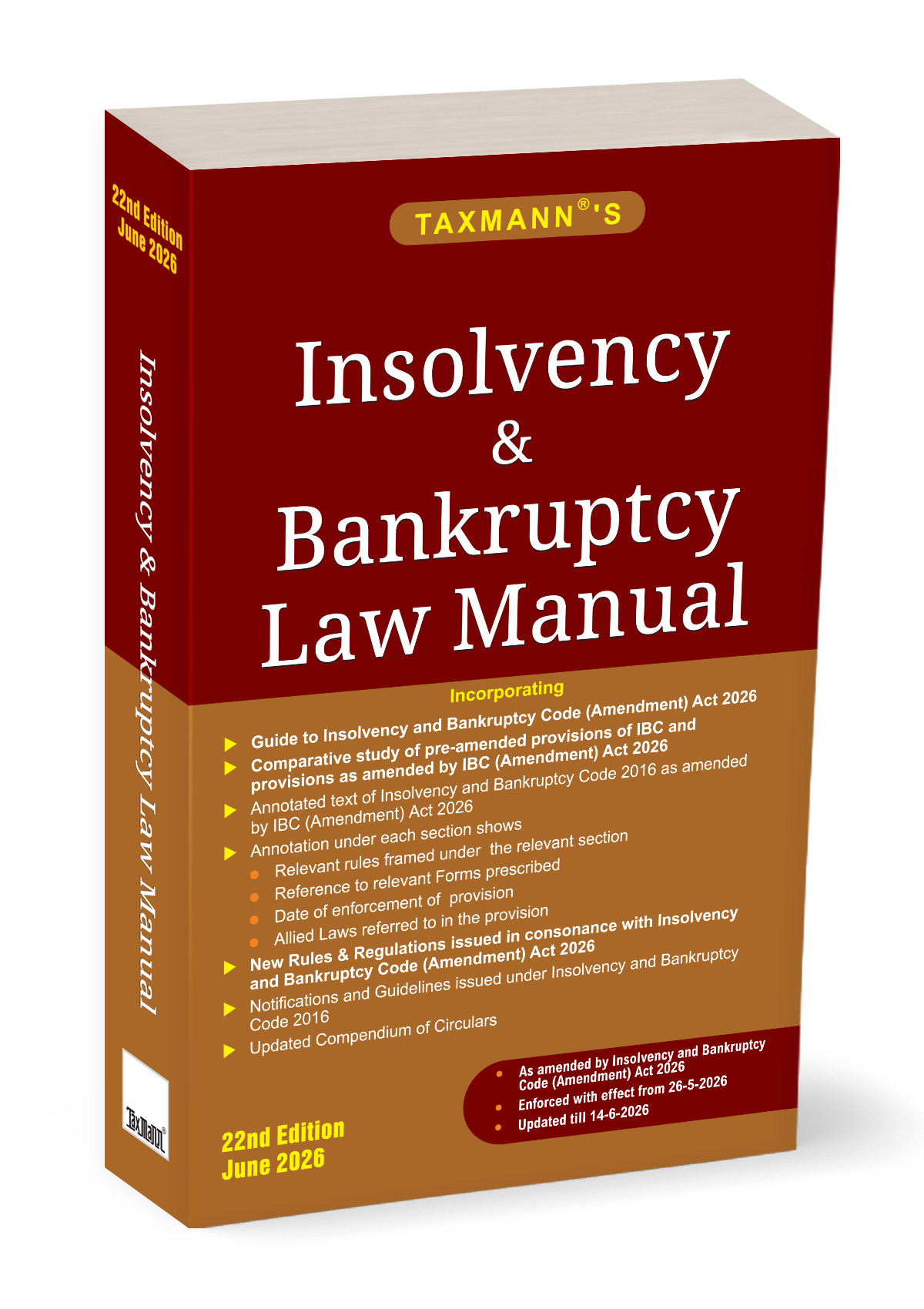
Description
Insolvency & Bankruptcy Law Manual is a comprehensive, single-volume compendium that consolidates the entire legal framework governing insolvency and bankruptcy in India as it stands after the Insolvency and Bankruptcy Code (Amendment) Act 2026. In one authoritative reference it brings together the annotated, amended text of the Insolvency and Bankruptcy Code 2016, together with every allied Rule, Regulation, Guideline, Notification and Circular issued under it.
What sets this Manual apart is that it does not merely reproduce the statute—it situates each provision within its complete operating ecosystem. Every section of the Code is annotated to show the relevant rules framed thereunder, the prescribed forms, the date of enforcement, and the allied laws referred to; many sections additionally carry section-wise notes and digests of case law. A reader can therefore move from statutory text to the machinery that implements it—and to how the courts have read it—without leaving the volume.
In short, it is built to be the definitive working desk reference—accurate, exhaustive and fully current—for anyone who needs the law of insolvency and bankruptcy, and the latest 2026 amendments, at their fingertips.
The Manual is written for everyone who engages with insolvency and bankruptcy law in practice, advisory, adjudication or study:
- Insolvency Professionals (IPs)—interim resolution professionals, resolution professionals, liquidators and bankruptcy trustees who need the Code, regulations and forms in one place, and who must come to grips with sharply redefined roles under the 2026 amendment
- Advocates and Law Firms appearing before the NCLT, NCLAT, High Courts and the Supreme Court in insolvency, liquidation and bankruptcy matters
- Chartered Accountants, Company Secretaries and Cost & Management Accountants advising on corporate insolvency, restructuring, valuation and compliance
- Registered Valuers, Insolvency Professional Agencies and Information Utilities operating within the IBBI framework
- Bankers, Lenders and Financial Creditors, as well as Operational Creditors and Corporate Debtors, navigating resolution, recovery and the new creditor-initiated route
- Members of the Judiciary, NCLT/NCLAT Benches and Regulators seeking a reliable, consolidated and current text
- Academicians and Students of Law, CA, CS and CMA Programmes requiring an authoritative, up-to-date statutory reference
The Present Publication is the 22nd Edition | June 2026, amended by the IBC (Amendment) Act 2026; brought into force vide Notification S.O. 2625(E) dated 22-5-2026, effective 26-5-2026; updated till 14-6-2026. This book is edited by Taxmann’s Editorial Board and offers the following noteworthy features:
- [Fully Amended & Updated] Incorporates the Insolvency and Bankruptcy Code (Amendment) Act 2026, with the law stated as updated till 14th June 2026 (including subordinate-legislation amendments effective up to 1st June 2026)
- [Dedicated Guide to the 2026 Amendment Act] A detailed, numbered walkthrough (52 points) explaining each substantive change, what it does, and the rationale drawn from the ‘Notes on Clauses’ and ‘Statement of Objects and Reasons’ appended to the Amendment Bill
- [Amendments at a Glance Table] A section-wise snapshot showing, for each amended section, the effective date and the precise nature of the change (inserted, substituted, omitted, etc.)
- [Section-wise Comparative Study] A clause-by-clause analysis placing the pre-amended provisions of the IBC side by side with the provisions as amended by the 2026 Act, each tagged with its enforcement date—so readers can instantly see exactly what changed and where
- [Section-wise Annotated Text of the IBC 2016] The annotation beneath each section shows:
- The relevant Rules framed under that section;
- Reference to the relevant Forms prescribed;
- The date of enforcement of the provision; and
- The allied laws referred to in the provision (cross-referenced to the Appendix of other Acts)
- [Section Notes & Case-Law Digests] Beyond the bare text and footnotes, many sections carry ‘Section Notes’ explaining the provision and digests of relevant ‘Case Laws,’ giving the Manual a built-in commentary layer
- [All New Rules & Regulations] Subordinate legislation issued in consonance with the 2026 amendment, reproduced in full
- [Notifications & Guidelines] Issued under the Code and consolidated for ready reference—including the latest Insolvency Professionals (Recommendation) Guidelines 2026
- [Updated Compendium of Circulars] All circulars issued under the IBC 2016, brought together in a single updated compendium
- [Self-contained Single Volume] The Code, its subordinate legislation and administrative instruments together, eliminating the need to cross-refer to multiple sources
- [Taxmann’s Signature Editorial Rigour] Verified text, exhaustive front-matter lists (Rules/Regulations, Notifications, Circulars, Guidelines) and a subject index for fast navigation
The Manual reproduces, in full, the following components of the law:
- Guide to the 2026 Amendment Act
- A Guide to the Insolvency and Bankruptcy Code (Amendment) Act 2026, plus an ‘amendments at a glance’ snapshot
- Comparative Study (Pre vs Post Amendment)
- In two parts—(I) a résumé of the amendments and their objectives, and (II) a section-wise comparison of pre-amended vs. amended provisions
- Annotated Text of the Code
- The text of the Insolvency and Bankruptcy Code, 2016, as amended by the IBC (Amendment) Act 2026—each section annotated for relevant rules, prescribed forms, dates of enforcement and allied laws, with many sections also carrying section notes and case-law digests, and footnotes that cross-reference the Appendix of other Acts
- Text of the Amendment Act 2026
- The full text of the IBC (Amendment) Act 2026, together with its Statement of Objects and Reasons and Notes on Clauses
- Appendix of Allied Acts & Subject Index
- An appendix of provisions of other Acts referred to within the Code, plus a Subject Index
- Rules & Regulations
- The complete body of Rules and Regulations framed under the Code—corporate insolvency resolution, liquidation and voluntary liquidation, fast-track and pre-packaged processes, personal guarantors to corporate debtors, information utilities, insolvency professionals/agencies and registered valuers
- Guidelines
- Guidelines issued under the IBC 2016, including the Insolvency Professionals (Recommendation) Guidelines 2026
- Notifications
- Notifications issued under the IBC 2016, including enforcement and removal-of-difficulties instruments
- Circulars
- An updated compendium of circulars issued under the Code
- Highlights of the IBC (Amendment) Act 2026 — The Guide and Comparative Study walk through the substance of the overhaul, including:
- Four Forward-looking Reforms (to be notified at a later date) — A creditor-initiated insolvency resolution process with an out-of-court initiation mechanism for genuine business failures; a group insolvency framework for complex corporate group structures; a cross-border insolvency framework aligning Indian practice with international best practice; and an electronic portal to facilitate procedures under the Code. (All remaining amendments took effect on 26th May 2026)
- Redefined Core Concepts — A new definition of ‘registered valuer’ [section 3(27A)] harmonised with Chapter XVII of the Companies Act, 2013; a new definition of ‘service provider’ [section 3(31A)]; and a clarified definition of ‘security interest’ [Explanation to section 3(31)] confirming that a charge created merely by operation of law (e.g., for unpaid tax or penalty) is not a security interest—easing long-standing disputes over priority of debts
- Avoidance Transactions & Wrongful Trading — New statutory concepts of ‘avoidance transaction’ and ‘fraudulent or wrongful trading,’ with resolution professionals or liquidators empowered to file applications before the Adjudicating Authority, and such proceedings made independent of, and able to survive, the CIRP and liquidation (and even dissolution)
- Faster, Tighter CIRP — Expeditious admission of a financial creditor’s section 7 application (record of default with an information utility treated as sufficient evidence; admission targeted within 14 days); recorded reasons for delay in section 9 and section 10 applications; and stricter limits on withdrawal of CIRP applications under section 12A
- A Reworked Liquidation Regime — CoC supervision of the liquidation process; the liquidator appointed by the IBBI (with the resolution professional who ran the CIRP barred from acting as liquidator); the CoC empowered to replace the liquidator; dissolution of the corporate debtor as an alternative to full liquidation where there are no meaningful assets; moratorium-style protection extended into liquidation; and removal of the duplicate claim-collation exercise (claims collated during CIRP are merely maintained and updated)
- Stronger Resolution-Plan Mechanics — Resolution plans may propose the sale of one or more specific assets; a committee to implement and supervise the resolution plan; a defined minimum payment to dissenting financial creditors; and a ‘clean slate’ under which claims and proceedings against the corporate debtor are extinguished on approval, with licences, permits, registrations and quotas continuing
- Anti-abuse, Discipline & Deterrence — Recalibrated look-back periods for preferential, undervalued and extortionate-credit transactions to curb pre-filing manipulation; penalties of up to ₹2 crore for frivolous or vexatious proceedings; a new power for the Adjudicating Authority to impose penalties for contraventions of the Code, rules or regulations; and a strengthened disciplinary regime for ‘service providers’ (insolvency professionals, agencies and information utilities), with appeals to the NCLAT
- Structural Clean-up & Further Refinements — Abolition of the Fast Track Insolvency Resolution Process (related sections omitted); alignment of the pre-packaged insolvency (PPIRP) provisions with the revised CIRP; an enabling provision to terminate a voluntary liquidation in specified situations; tighter secured-creditor realisation timelines and thresholds in liquidation; enhanced information-utility authentication; and an expanded duty on past employees, promoters and service providers to cooperate with the IRP
The Manual is organised into five clearly demarcated Divisions, preceded by a rich set of guides and reference lists.
- Prefatory/Reference Section — List of Rules/Regulations · List of Notifications · List of Circulars · List of Guidelines · Amendments made by the IBC (Amendment) Act 2026 at a glance · Guide to the IBC (Amendment) Act, 2026 · Comparative study of pre-amended and amended provisions (Résumé & Section-wise study)
- Division One | Insolvency and Bankruptcy Code 2016 — Arrangement of Sections; the annotated text of the Code as amended (with footnotes, section notes and case laws); an appendix of provisions of other Acts referred to in the Code; the text of the IBC (Amendment) Act 2026; Subject Index; Statement of Objects and Reasons; and Notes on Clauses
- Division Two | Rules and Regulations — The complete set of Rules and Regulations made under the Code—from model bye-laws and professional/agency regulations through the corporate insolvency, liquidation, voluntary liquidation, personal-guarantor and pre-packaged insolvency frameworks, plus the Companies (Registered Valuers and Valuation) Rules 2017
- Division Three | Guidelines Issued Under the IBC 2016 — The full collection of operative guidelines—technical standards for information utilities, empanelment of advocates, committee of creditors, continuing professional education, valuation disclaimers, and the Insolvency Professionals (Recommendation) Guidelines 2026
- Division Four | Notifications Issued Under the IBC 2016 — A consolidated set of notifications, including enforcement and removal-of-difficulties instruments
- Division Five | Circulars Issued Under the IBC 2016 — An updated compendium of all circulars issued under the Code
- This division-based architecture lets a reader move logically from the statute, to its subordinate legislation, to the administrative guidance that governs day-to-day practice

Reviews
There are no reviews yet.