
| Content | Page |
| Chapter 1. Introduction | |
| Foundational principle for a charge under Tax Statutes | 1 |
| Purpose of Interpretation | 1 |
| Statute must be read as a whole | 2 |
| Sources of Rules | 2 |
| Particulars in a Statute | 3 |
| Tools in interpretation | 4 |
| Internal aids to construction vis-a-vis External aids to construction | 7 |
| Preliminary Steps before attempting to interpret a given statute: | 8 |
| Special Law Overrides General Law | 9 |
| Principles of Statutory Interpretation | 10 |
| A statute is either perpetual or temporary | 17 |
| Undefined words | 19 |
| Definitions in other statute | 19 |
| Plain Meaning Rule | 20 |
| Rules of Language | 20 |
| Judicially defined words | 21 |
| Chapter 2. Act | |
| Which can we Regard as the special Act and which the General ? | 23 |
| When both the Acts show non-obstante clauses; therefore, the question which arises for consideration is which Act will prevail | 24 |
| Chapter 3. Amendment | 26 |
| Chapter 4. An Act to Amend and Consolidate the Law | |
| Meaning of consolidation of the law | 28 |
| Objective of Income-tax Act, 1961 | 28 |
| Chapter 5. Annul | 29 |
| Chapter 6. Bare Act | |
| Literal Interpretation | 32 |
| Contents of Bare Act | 32 |
| Role of ‘Preamble’ in interpretation of statute | 32 |
| Examples of Bare Act | 33 |
| Chapter 7. Casus Omissus | |
| The casus omissus cannot be supplied by the Courts Supplying ‘casus omissus’ which was not permissible and could | 35 |
| only have been done by the Supreme Court in an appropriate case Casus omissus broadly refers to the principle that a matter which has not been provided in the statute but should have been there, | 36 |
| cannot be supplied | 36 |
| Chapter 8. Caveat | |
| Meaning of a Caveat | 37 |
| Content to Be included in a Caveat | 37 |
| Purpose of a Caveat | 38 |
| Where can a Caveat be Lodged? | 38 |
| Chapter 9. Charging Provision | |
| Charging section should be strictly construed while the procedural sections should be liberally interpreted | 40 |
| Chapter 10. Circulars or Instructions | |
| Nature of a CBDT circular can be summarised in the words of Hon’ble Supreme Court | 42 |
| Binding Nature of Circular/Instruction | 43 |
| Chapter 11. Clause | |
| Clue to Identify whether a part of section is Clause or Sub-section | 47 |
| Chapter 12. Code | |
| Chapter 13. Collegium | |
| Dispute Resolution Panel (DRP) is an income-tax authority | 50 |
| Chapter 14. Cross-Examination | |
| What is Cross-Examination? | 51 |
| Requests for cross-examination may be denied | 51 |
| Types of Evidence | 52 |
| Technical Rules of Evidence do not Apply to Income Tax Proceedings | 52 |
| Lack of cross-examination & violation of principle of natural justice | 52 |
| Chapter 15. Definition Clause (Interpretation) | |
| Definitions in other statutes | 68 |
| Chapter 16. Deletion | 69 |
| Chapter 17. De Novo | 70 |
| Chapter 18. Derived From | 72 |
| Chapter 19. Dismiss | |
| ‘Appeal is Dismissed’ | 74 |
| Dismissal of Appeal by Appellate Commissioner | 74 |
| “SLP Dismissed” : | 74 |
| SLP is Dismissed, however, the question of law is kept open | 75 |
| Chapter 20. Ejusdem Generis | |
| Need for the Doctrine | 77 |
| Essentials of the Doctrine of Ejusdem Generis | 78 |
| Chapter 21. Error of Jurisdiction or Lack of Jurisdiction (Excessive Jurisdiction) | |
| Nullity when occurs | 80 |
| Jurisdictional Error | 81 |
| Few Instances: Jurisdictional Error | 81 |
| Lack of Jurisdiction (Excessive Jurisdiction) | 81 |
| Few Instances: Lack of jurisdiction (excessive jurisdiction) | 82 |
| Chapter 22. Estoppels | |
| Requirements of Promissory Estoppel | 95 |
| Conditions for application of Doctrine of Estoppel | 96 |
| Exceptions to Estoppel | 96 |
| Principles of estoppel not apply to Income Tax proceedings | 96 |
| Doctrine of Promissory Estoppel is not Applicable Against the State while Exercising its Legislative Power | 97 |
| Chapter 23. Exception | |
| Exceptions & saving clauses | 100 |
| Chapter 24. Exemptions | |
| Exemption Clause – Strict Construction | 101 |
| Chapter 25. Explanation | |
| Object of an Explanation to a statutory provision | 106 |
| Chapter 26. For the Removal of Doubts | |
| Clarificatory or Retrospective – who decides | 110 |
| Chapter 27. Full and True Disclosures | |
| What is full and true Disclosure | 111 |
| What does full and true Disclosure mean | 111 |
| Chapter 28. Includes | |
| Chapter 29. Income | |
| Inclusion of all sorts of subsidies within ambit of ‘Income’ under Section 2(24) is not unconstitutional | 115 |
| Term “income” as defined in section 2(24) does not include “interest” referred to in section 56(2)(viii) or interest received in MACT award | 116 |
| Chapter 30. Income Tax Law | 119 |
| Chapter 31. Judicial Discipline | |
| Assessing Officer is bound to follow High Court ruling given in assessee’s favour even if Department has filed SLP against the decision to Supreme Court | 121 |
| An order of High Court does not become inoperative merely because Department filed an appeal or SLP against it | 121 |
| Binding nature of order of another bench – Judicial discipline [Article 226] | 122 |
| Judicial discipline demands that subordinate authorities shall accept the decisions of Tribunal as binding precedent | 122 |
| Chapter 32. Judicial Precedents | |
| Meaning of Precedent | 124 |
| Definition of Precedent | 125 |
| Origin of Precedent | 125 |
| Object of Doctrine of Precedent | 125 |
| Binding nature of Precedents | 126 |
| General Principles | 126 |
| Exception to the doctrine of Precedents, i.e., when Precedent ceases to be Binding | 126 |
| Legislative Amendment | 128 |
| Chapter 33. Law | |
| Judges to Apply the Law | 157 |
| Meaning of Law | 157 |
| “LAW” Defined | 158 |
| Generally the term “law” is used to mean three things: | 159 |
| Origin of Law | 159 |
| Nature of Law | 160 |
| Functions of law | 160 |
| Rule of Law | 161 |
| Role of law in Business | 161 |
| Role of law in Society | 161 |
| Forbidden by Law mean: | 162 |
| Chapter 34. Literal Rule | |
| Advantages of the Literal Rule | 165 |
| Disadvantages of the Literal Rule | 165 |
| Chapter 35. Machinery Provision | |
| While interpreting machinery provisions of a Taxing Statute Court should give effect to its Manifest purpose: SC | 167 |
| Chapter 36. Mandatory or Directory | |
| Difference between Mandatory and Directory provisions | 170 |
| Rules for determination of Mandatory and Directory Statute | 172 |
| Intention of the legislature: | 172 |
| Purpose behind the Statute: | 172 |
| Chapter 37. Marginal Notes | |
| Definition of Marginal Notes: | 176 |
| Limitations of Marginal notes as internal aid to construction: | 176 |
| Chapter 38. May or Shall | 179 |
| Chapter 39. Means | 181 |
| Chapter 40. Mutatis Mutandis | 183 |
| Chapter 41. Natural Justice | |
| Adjournments | 185 |
| Situations of violation of principles of natural justice in taxation laws | 185 |
| Rule against Bias | 187 |
| “Justice must not only be done, but must be seen to be done” | 187 |
| Right to Fair Hearing | 188 |
| Chapter 42. Non – Obstante Clauses | |
| Non-obstante clause in Section 153A does not exclude Applicability of Reassessment Proceedings | 204 |
| Bombay High Court decodes Non Obstante Clause | 204 |
| Non-obstante clauses are not always to be regarded as Repealing Clauses nor as clauses which expressly or completely supersede any other Provision of the Law | 207 |
| Chapter 43. Nothing Contained In | 208 |
| Chapter 44. Notwithstanding Anything Contained In… Distinction between the Expression ‘Subject to other provisions’ and the expression “Notwithstanding anything Contained in..” | 211 |
| Chapter 45. Obiter Dicta | 212 |
| Chapter 46. Omission | 214 |
| Chapter 47. Oral Order or Judgment | |
| Oral and Written Judgments | 218 |
| What is a Judgment? | 218 |
| The term ‘Judgment’ has been defined under section 2(9) of the Civil Procedure Code as under: | 218 |
| Judges should speak through Judgements and Orders, not issue oral directions: Supreme Court | 218 |
| Chapter 48. Per Incuriam | |
| A Decision is given per Incuriam when the Court has Acted | 220 |
| Tribunal has no Jurisdiction to hold that a Particular Decision of Jurisdictional High Court has been rendered per Incuriam or sub Silentio | 222 |
| The Proposition that a decision per Incuriam need not be followed as a Binding Precedent is Well-established | 224 |
| Chapter 49. Perversity | |
| Perverse | 225 |
| Test and Benchmark of Perversity is Far Stringent and Strict | 225 |
| Chapter 50. Precedent | |
| Doctrine of Precedent in India – a British Legacy | 238 |
| Pre-Independence | 238 |
| Post-Independence | 238 |
| Supreme Court | 238 |
| High Courts | 238 |
| Lower Courts | 239 |
| Precedents | 239 |
| Rules for Reading the Precedents | 239 |
| Circumstances that Weaken the Binding force of a Precedent | 239 |
| Precedent ceases to be a Binding Precedent | 239 |
| Circumstances Weakening the Binding force of Precedents | 240 |
| Constitutional provisions regarding precedents of the Supreme Court – Scope of Article 141 | 240 |
| Use of Foreign Decisions | 242 |
| Chapter 51. Prescribed | |
| Chapter 52. Presumption | |
| What is the Presumption of Statutes? | 244 |
| Taxing Statute is to be Construed Strictly | 245 |
| Presumption against Injustice or Absurdity | 246 |
| Chapter 53. Procedural law | |
| Meaning of Procedural Law | 247 |
| Nature of Procedural Laws | 248 |
| Chapter 54. Proceeding | 252 |
| Chapter 55. Prohibited By Law | |
| What is Meaning of ‘Prohibited by Law’ | 255 |
| Duties of an Auditor while Conducting tax audit of a Pharma Company under Section 44AB of the Act | 256 |
| Supreme Court’s decision | 256 |
| Chapter 56. Prospective | |
| Meaning of the Word “Prospective” | 259 |
| Prospective vs. Retrospective – Cardinal Principle of the Tax Law | 259 |
| Supreme Court provides clarity on Prospective versus Retrospective operation of Tax Amendments | 259 |
| Chapter 57. Proviso | |
| Proviso (a Condition) : | 262 |
| How to know the NUMBER of a Proviso? | 263 |
| Chapter 58. Punctuation | 265 |
| Chapter 59. Quash | |
| What is a Quashing order? | 266 |
| Chapter 60. Ratio Decidendi | |
| Ratio decidendi (Literally means ‘Reason for Deciding’) | 267 |
| Law of Precedents | 268 |
| Elements of a Precedent | 268 |
| Constitutional Provisions Regarding precedents of the Supreme Court – Scope of Article 141 | 268 |
| Ratio decidendi : The reason or Grounds of a Judicial Decision | 270 |
| Chapter 61. Removal of Difficulty | |
| Removal of Difficulty order may be made under a Statute Subject to the following Requirements being met up with: | 271 |
| Chapter 62. Repeal | |
| Effect of Repeal [Section 6 of General Clauses Act, 1897] | 273 |
| Contents | xv |
| Section 6A : Repeal of Act making Textual Amendment in Act or Regulation | 274 |
| Subordinate Legislation under the Repealed Statutes | 274 |
| Chapter 63. Res Judicata | |
| For making Res Judicata Binding, Several Factors must be met up with: | 276 |
| The Doctrine of Res Judicata is based on Three Roman Maxims: | 276 |
| Key Principles of Res Judicata | 277 |
| Applicability of Res Judicata | 277 |
| Non-Applicability of Res Judicata | 277 |
| Purpose of Res Judicata | 277 |
| The Nature of Res Judicata | 277 |
| Scope of Res Judicata | 278 |
| Res Judicata of Foreign Judgement – Execution of Foreign Awards and Decrees in India | 278 |
| Chapter 64. Retrospective | |
| Meaning of Retrospective | 285 |
| Nature of Retrospective Legislation | 285 |
| Retrospective Operation Means | 286 |
| Clarificatory or Retrospective – Who decides | 287 |
| Constitutional Restriction on Retrospective Laws | 287 |
| Chapter 65. Rule | 320 |
| Chapter 66. Rule Absolute | 321 |
| Chapter 67. Save as Otherwise Provided in This Act… | 322 |
| Chapter 68. Saving Clauses | 323 |
| Chapter 69. Schedule | 325 |
| Chapter 70. Section | 327 |
| Chapter 71. Sub – Section | |
| Sub-section Example | 328 |
| Clue to locate a ‘Sub-section’ in a Section | 328 |
| Section & Sub-section’ | 328 |
| Chapter 72. Set – Aside | 329 |
| Chapter 73. Short Title | 332 |
| Chapter 74. Stare Decisis | 333 |
| Chapter 75. Subject to the Provisions of… | |
| Difference between: (a) ‘Non-obstante’ Clause and (b) ‘Subject to’ other Provisions | 337 |
| Chapter 76. Sub-Silentio | 339 |
| Chapter 77. Substantive Provisions versus Technical Provisions | |
| Sequencing of Provisions | 342 |
| Contents | xvi |
| Chapter 78. Substantive Law | |
| Concept of Substantive Law | 352 |
| Meaning and Nature of Substantive Laws | 352 |
| Nature of Substantive Laws | 353 |
| Sources of Substantive Laws | 353 |
| Other Sources of Substantive Laws include: | 354 |
| Limitations of Substantive Laws | 354 |
| Chapter 79. Suo Moto | |
| Notable Cases | 355 |
| Chapter 80. Sufficient Cause | |
| Meaning of the word “sufficient cause” | 361 |
| Chapter 81. Tax | |
| Definition of Tax: | 370 |
| Strict Construction of Taxing Statutes | 370 |
| Constitutional Aspects of Taxation | 371 |
| Constitutional Provisions Relating to Taxation | 371 |
| Taxes are the Price that we Pay for Civilization | 379 |
| Chapter 82. Ultra Vires | |
| Meaning of Ultra Vires | 380 |
| Constitutional Validity | 381 |
| Chapter 83. Without Prejudice To… | |
| ‘Without Prejudice’ Means | 383 |
| Chapter 84. Important Common Legal Terms | 385 |
| Chapter 85. Interpretation Act, 2005 | 394 |
| Chapter 86. The General Clauses Act, 1897 | 408 |
-3%
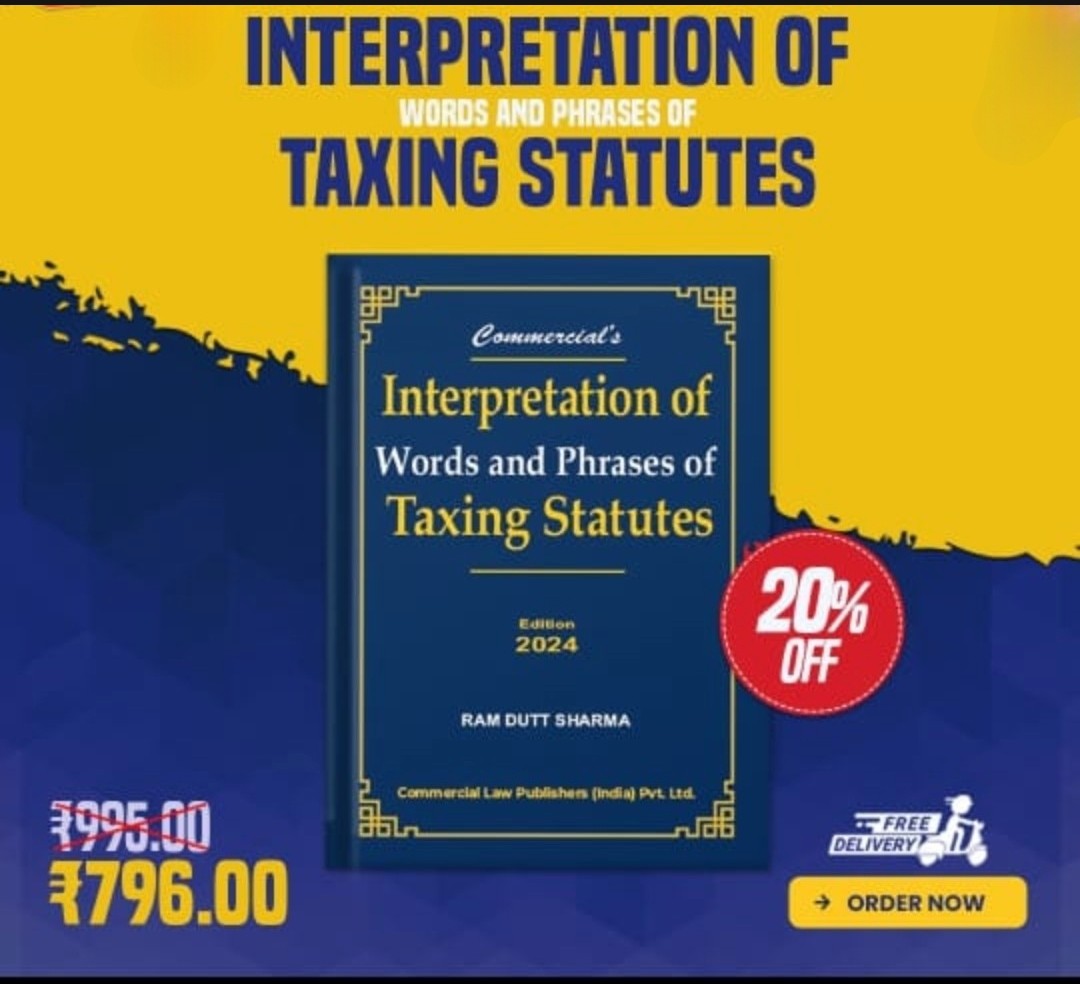
INTERPRETATION OF WORDS AND PHRASES OF TAXING STATUTES BY RAM DUTT SHARMA
Original price was: ₹995.00.₹969.00Current price is: ₹969.00.
0
People watching this product now!
Description
Reviews (0)


Reviews
There are no reviews yet.