
Description
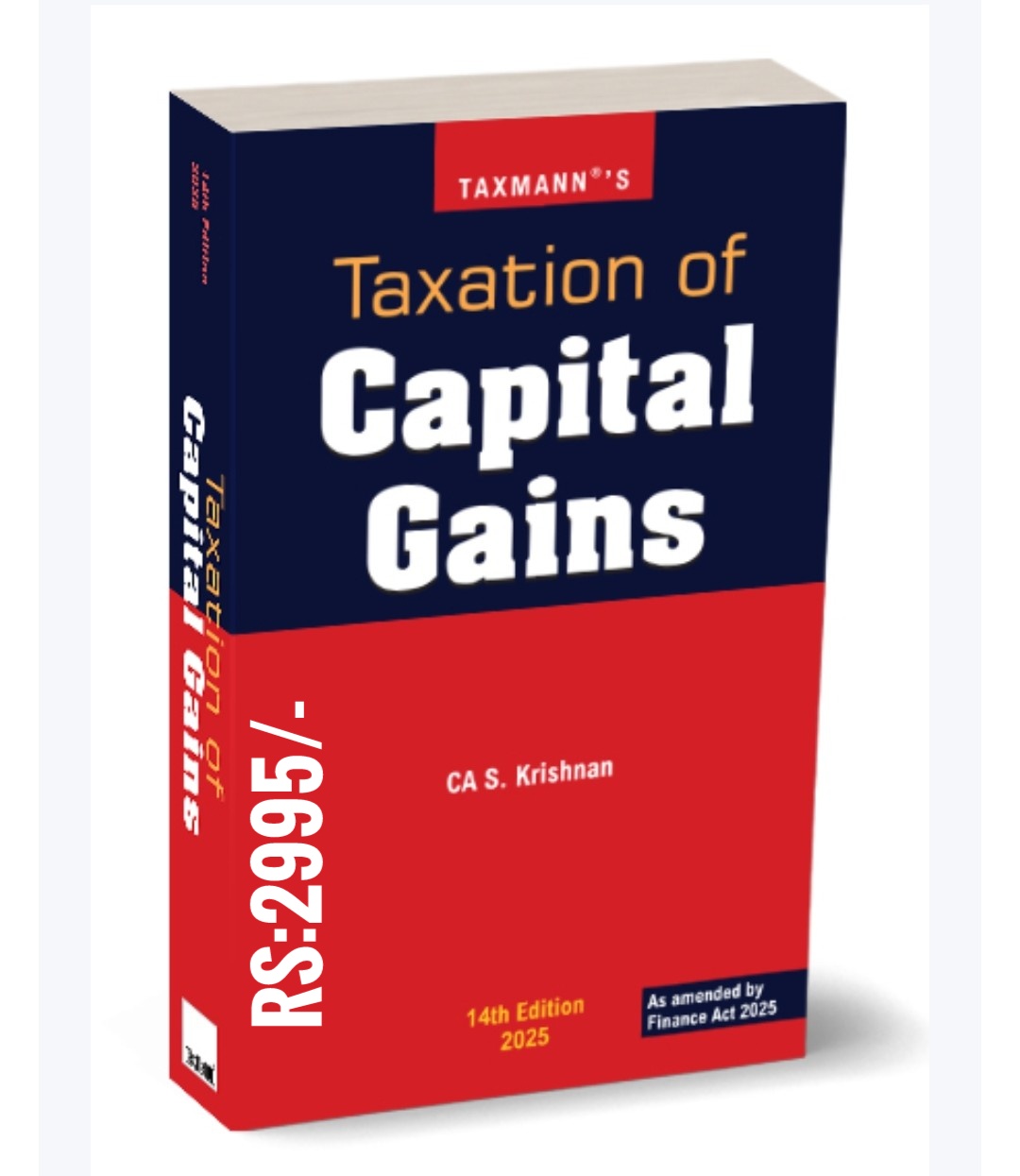
Taxation of Capital Gains (14th Edition | 2025) is a comprehensive and updated treatise that simplifies the entire spectrum of capital gains taxation under the Income-tax Act. It presents the latest amendments introduced by the Finance Act 2025, including detailed explanations of the revised indexation provisions and other key changes. The book simplifies complex legal stipulations around capital gains and provides practical insights into tax planning, compliance, and dispute resolution. Building on the author’s extensive research and practical consulting experience, this Edition thoroughly discusses every nuance of the law—from the definition of ‘capital asset’ and the intricacies of ‘transfer’ to advanced areas like slump sale, transactions involving partnerships (new Sections 45(4) & 9B), and the unique issues faced by Non-Resident Indians (NRIs). It incorporates pragmatic examples and coverage of landmark judicial decisions.
This book is intended for the following audience:
- Chartered Accountants & Tax Professionals – Ideal for those providing advisory or compliance services, as it offers step-by-step guidance, case law references, and illustrative examples
- Legal Practitioners & Corporate Tax Teams – Helps lawyers, in-house counsel, and finance professionals interpret legislative changes and handle capital gains issues efficiently
- Academicians & Students – Serves as an authoritative reference for postgraduate students, researchers, and faculty specialising in taxation or commercial law
- NRIs and Financial Advisors – Provides in-depth discussion and compliance checklists for NRIs, highlighting practical strategies for capital gains tax planning on their Indian assets
- Anyone Involved in Real Estate & Investment – Offers detailed sections on real estate transactions, shares and securities, and joint development agreements, making it indispensable for property investors, builders, and other stakeholders
The Present Publication is the 14th Edition | 2025, amended by the Finance Act 2025. This book is authored by CA. S. Krishnan with the following noteworthy features:
- [Latest Amendments Covered] Detailed exposition of changes introduced by the Finance (No. 2) Act 2024 and Finance Act 2025, including the critical revisions to Sections 112, 112A, 10(10D), and 2(14)
- [Comprehensive Analysis] Discusses all facets of capital gains taxation—from fundamental definitions (‘capital asset’ and ‘transfer’) to advanced topics like slump sale, reverse mortgage, and intangible assets
- [Practical Insights & Planning Strategies] Contains practical examples, planning tips, and advanced guidance, especially on capital gain tax planning for real estate, securities, and NRIs
- [Latest Judicial Precedents & Circulars] Incorporates important case laws, including recent judgments from the Calcutta High Court (February 2025) and the Supreme Court (February 2025), along with relevant CBDT circulars and notifications
- [Special Focus on NRIs] A dedicated chapter explaining NRIs’ tax obligations, TDS provisions, and practical compliance when disposing of property in India, plus tax planning for those returning to India
- [Step-by-step Computation] Detailed guidance on computing capital gains (short-term and long-term), indexing, and the permissible deductions under various rollover provisions (Sections 54, 54EC, 54F, etc.)
- [User-friendly Structure & Illustrations] Each chapter is replete with illustrative examples, tables, and checklists to simplify complex provisions
- [Insights on Partnership & Reconstitution (Section 45(4) & Section 9B)] Clarifies the newly introduced regime for taxation of assets received by partners/members on reconstitution or dissolution of a firm, LLP, AOP, or BOI
- [Author’s Authority & Practical Expertise] S. Krishnan is a third-generation Chartered Accountant with 50 years of tax practice, specialising in capital gains. His practical advisory experience and research-based approach bring invaluable insights and clarity to readers
The coverage of the book is as follows:
- Preface & Amendments
- Lays the background to the recent amendments, discussing government rationales behind indexation changes, new capital gains regimes, and interplay with other sections.
- Core Chapters (0–33)
- Chapter 0 – Amendments Made by the Finance (No. 2) Act, 2024
- Chapter 1–5 – Foundational concepts—scope of capital gains, definition of ‘capital asset,’ classification into short-term and long-term, and transactions that do not trigger taxable capital gains
- Chapter 6–6B – Year of taxability, taxation of ULIPs, and partnership reconstitution (Sections 45, 9B, and other allied provisions)
- Chapters 7–12 – Computation mechanics—full value of consideration, expenditure on transfer, cost of acquisition/improvement, and indexed cost
- Chapters 13–16B – Rollover deductions (Sections 54, 54B, 54D, 54EC, etc.), including exhaustive coverage of practical applications and a separate chapter on NRIs (16B)
- Chapters 17–25 – Treatment of capital gains in specialised contexts (units of specified funds, startup investments under Section 54GB, valuation officer references, etc.)
- Chapters 26–33 – Loss under capital gains, liquidation scenarios, buy-back of shares, depreciable assets, slump sale, intangible assets, charitable trusts, and real estate transactions in depth
- Appendices & Notifications
- Comprehensive appendices providing the text of relevant notifications, circulars, and relaxation provisions triggered by emergencies (historically COVID-19)
The structure of the book is as follows:
- Logical Flow of Topics – Starts with the basics of capital gains taxation, gradually advancing towards complex issues and special circumstances
- Self-contained Chapters – Each chapter stands independently, providing statutory references, interpretative case laws, relevant circulars, and examples
- Amendments Highlighted within Each Chapter – The most recent changes are seamlessly integrated into relevant chapters, ensuring readers can see their practical impact immediately
- Dedicated Chapters for Special Topics – Subjects like NRI taxation, ULIPs, slump sale, and exemptions have been given focused chapters, aiding quick access and in-depth study
- Extensive Use of Tables and Examples – Summaries, tabular presentations, and example-based clarifications make intricate topics understandable and user-friendly
Read Less
About the author
S. Krishnan
- Krishnan, a distinguished Chartered Accountant from a family of Chartered Accountants, completed his Chartered Accountancy course in 1974 and established his practice in Chennai. With over five decades of experience, he has handled Statutory, tax, and internal audits for various industries, including banks, hotels, and other industrial concerns. However, His true expertise lies in Capital Gains in Direct Taxes and Works Contracts in Indirect Taxes, where he has developed a profound specialisation and passion.
- Krishnan is renowned for his niche in Capital Gain tax planning, providing strategic advice to clients and dedicating substantial time to this field. His deep commitment to staying abreast of the latest legal provisions and court rulings on Capital Gain tax issues fuels his extensive research and analytical work. He actively contributes to various tax advisory publications, including Taxmann’s Journals, where he shares his insights on complex topics such as capital gain tax planning, issues under different sections of the Income-tax Act, taxation of NRIs, withholding tax under Section 195, family settlements, property transfers for inadequate consideration, and more.
With over 280 articles on Direct Taxes to his credit, S. Krishnan has established himself as a prolific contributor. He believes in the importance of continuous learning, emphasising that each capital gain tax issue is unique and requires ongoing study and understanding to navigate effectively.
Read More…


Reviews
There are no reviews yet.