
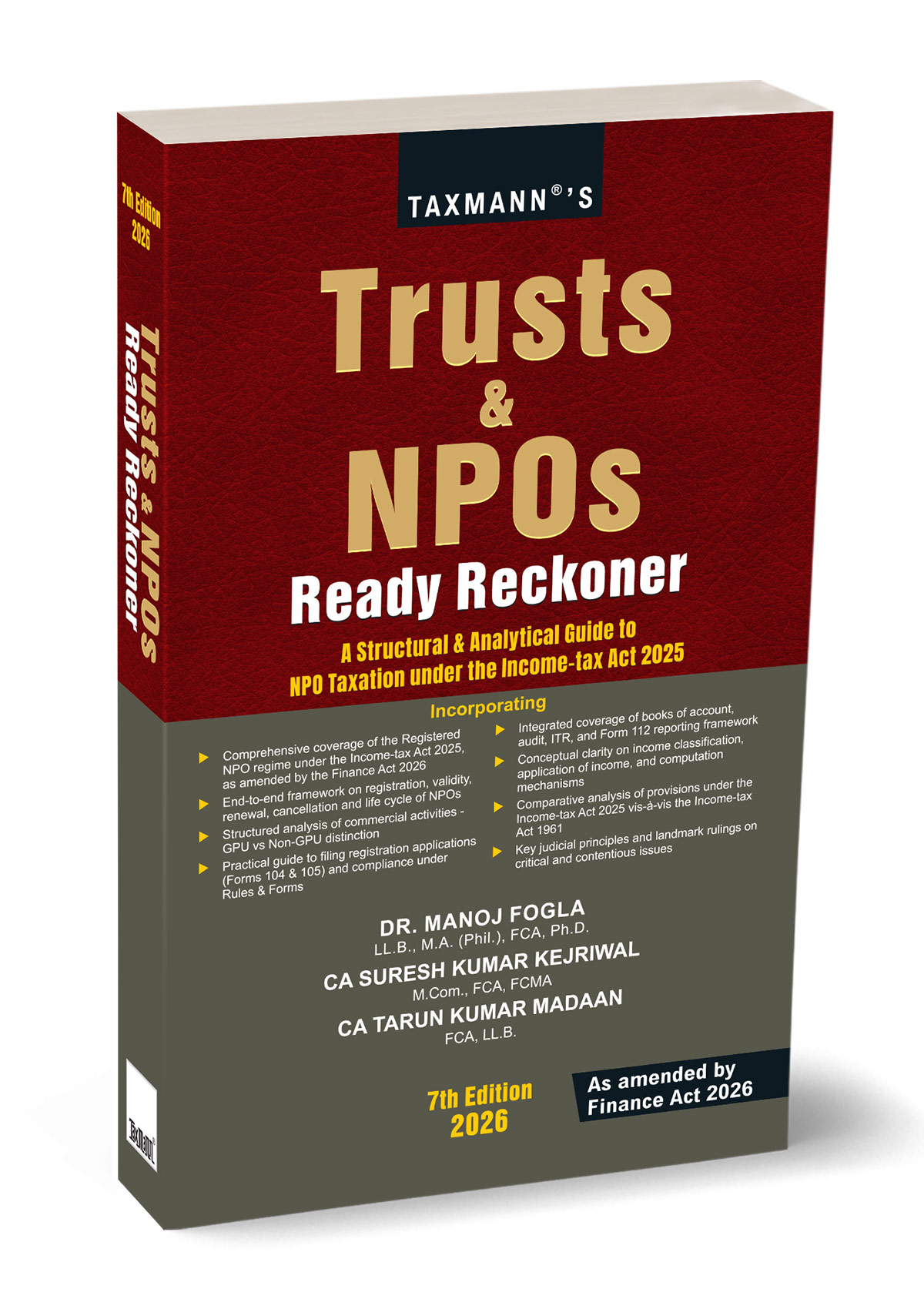
Description
Trusts & NPOs Ready Reckoner This is a structural and analytical commentary on the law governing Indian non-profit organisations under the Income-tax Act 2025, as amended by the Finance Act 2026. It walks through every operative provision of Part B of Chapter XVII (Sections 332 to 355) in statutory sequence, maps each provision to its counterpart under the Income-tax Act 1961, and addresses contentious issues with reference to judicial precedent. It engages with the Income-tax Rules 2026, Schedule XVI on permissible modes of investment, and the redesigned Form 104–114 architecture, which replaces Forms 10A, 10AB, 10AC, 10AD, 9A, 10, 10B, and 10BD. The authors together bring over three decades of practice in the charitable and voluntary sector, and the commentary is designed as the working reckoner for the complete life cycle of a registered non-profit organisation under the new statute.
This book is intended for the following audience:
- Chartered Accountants, Tax Practitioners, Audit Professionals and Consulting Firms advising public trusts, registered societies, Section 8 companies, universities, hospitals, religious institutions and government-financed entities
- In-House Finance, Compliance, Legal and Secretarial Teams of NPOs, Foundations, Religious Trusts, Educational and Medical Institutions, Research Bodies and Statutory Authorities
- Trustees, Governing Council Members, Settlors, Founders and Senior Executives responsible for registration, governance, accumulation decisions, investment policy, related-party transactions and statutory filings
- CSR Heads, Corporate Sustainability Teams, CFOs and Boards of CSR-Eligible Companies handling implementing-agency due diligence, impact assessment, project structuring, surplus management and CSR expenditure
- International Donor Agencies, Philanthropic Foundations and Grant-Making Bodies routing funds through Indian NPOs or operating India-facing programmes
- Counsel, Litigators and Tax Controversy Professionals handling registration, cancellation, accreted income, anonymous donation, related-person benefit and Schedule-based exemption proceedings before assessing officers, the CIT(A), ITAT, High Courts and the Supreme Court
- Departmental Officers (PCIT/CIT and Assessing Officers) examining registration applications, audit reports, ITRs, accumulation statements, change-of-purpose applications and accreted income computations
- Co-operative Societies, Mutual Concerns, Clubs and Member-Based Associations, navigating the intersection of the doctrine of mutuality with the NPO framework
- Academicians, Researchers, Faculty and Students of taxation law, charity law and not-for-profit governance, particularly those tracking the ITA 1961 to ITA 2025 transition
The Present Publication is the 7th Edition | 2026, amended by the Finance Act 2026 along with references to the Income-tax Rules 2026 and operative Forms 104 to 114. This book is authored by Dr Manoj Fogla, CA. Suresh Kumar Kejriwal & CA. Tarun Kumar Madaan, with the following noteworthy features:
- [Lifecycle-based Architecture] Built around Part B of Chapter XVII, with each chapter aligned to a specific stage in the registered NPO life cycle—from registration under Section 332 through to interpretation under Section 355
- [Uniform Chapter Design] A consistent internal architecture across all 78 chapters
- Chapter Summary
- Statutory Text Reproduced Verbatim
- Conceptual Analysis
- Worked Illustrations
- Comparative Tables
- Judicial Precedent
- Closing Comparative Paragraph against the ITA 1961
- [ITA 1961 vs ITA 2025 Comparison] Section-by-section comparative mapping of every material provision under the ITA 2025 against its ITA 1961 counterpart, identifying continuities, departures, re-locations and silent omissions—notably the disappearance of Section 164(2) rate-protection, the ‘property held under trust’ language and the express new category of ‘residual income’
- [Form-wise Practical Guides] Coverage of the entire Form 104 to Form 114 family—field-wise summaries, timelines, processing mechanics and consequences of non-filing—together with a comparative mapping against Forms 10A, 10AB, 10AC, 10AD, 9A, 10, 10B and 10BD; supplemented by a clause-wise walkthrough of Form 112 (unified audit report) across its 43 numbered clauses and Schedules A to ZL, covering related-person disclosure, specified violations, depreciation contraventions, loans and deposits, and Chapter XIX-B TDS/TCS compliance
- [Transition & Parallel Regimes] Dedicated treatment of the Section 536 savings framework and the resulting need to operate under the ITA 1961 and the ITA 2025 in parallel for several years
- [GPU vs Non-GPU & Size-based Classification] Distinct treatment of GPU and non-GPU NPOs throughout, reflecting the structural segregation under Sections 345 and 346 (with the 20% receipts threshold for GPU entities); together with coverage of the Small/Large Registered NPO classification—the revised thresholds of ₹5 crore regular income, ₹10 lakh foreign contribution and ₹10 lakh application outside India, and the ten-year extended validity for small NPOs under Section 332(5)
- [Contentious & Grey-area Issues] Engagement with the migration of judicial precedent from an exemption regime to a regulatory code; the ejusdem generis question on Section 2(49)(w); indexation on capital gains; diversion-by-overriding-title; QR-code era anonymous donations; the interaction between Section 311 and unregistered NPOs (with Circular No. 320 of 11th January 1982); and the continued allowability of CSR expenditure under Sections 28, 33, 45, 47 and 133
- [Landmark Judicial Rulings] Treatment of landmark rulings whose continued application under the ITA 2025 is expressly assessed—CIT v. Institute of Banking Personnel Selection, Bangalore Club v. CIT, CIT v. Secundrabad Club, Yum! Restaurants (Marketing) v. CIT, Chelmsford Club v. CIT and CIT v. Bankipur Club
- [Author Notes] Flags revisions to MCA FAQs, departmental positions and judicial developments where the position has moved since the underlying guidance was issued
- [Self-contained Appendices] Three Appendices reproducing the relevant Sections of the ITA 2025, Rules of the Income-tax Rules 2026 and Forms—making the volume self-contained
The coverage of the book is as follows:
- Legislative Evolution & Structural Reform
- The journey from the ITA 1961 to the ITA 2025: Budget speech, Bill, Select Committee Report, withdrawal, re-introduction, passage, Presidential assent and entry into force; the structural simplification (800+ sections, 1,200+ provisos, 900+ Explanations reduced to 536 self-contained sections); the unified ‘tax year’ concept; the relocation of permissible modes from Section 11(5) to Schedule XVI; the consolidation of NPO provisions from Chapters I, III, VIA, XII and XII-EB of the ITA 1961 into the single self-contained code of Part B of Chapter XVII (Sections 332–355); the new concept of ‘Registered Non-Profit Organisation’ under Section 355(g); the meaning of ‘specified provision’ under Section 355(m); and the disappearance of the dual registration/approval track
- Conceptual Shift & Savings Framework
- The shift from exemption language to computation language; the relocation from Chapter III to Chapter XVII-B; the contrast between the declared intent of ‘no structural change’ and the actual statutory design; and the savings framework under Section 536 governing pre-1 April 2026 matters
- Charitable & Religious Purpose | Foundational Definitions
- Meaning and scope of ‘Charitable Purpose’ under Section 2(23) across all limbs—relief of the poor, education, yoga, medical relief, preservation of environment and monuments, and advancement of any other GPU object—and the relocation of the GPU commercial-activity proviso from the definition to Section 346; meaning and scope of ‘Religious Purpose’; partly charitable and religious NPOs; public versus private religious purposes; benefit to a particular religious community or caste; and foundational definitions (‘tax year’, ‘person’, ‘income’ under Section 2(49), ‘total income’) in NPO context
- Constitution of NPOs & Amendment of Trust Deeds
- Constitution of NPOs across legal forms (public trust, registered society, Section 8 company, university, educational institution, hospital); comparative tables; interaction with the Indian Trusts Act, Societies Registration Act, Companies Act, FCRA and GST; and amendment of trust deeds (rectification, supplementary deeds, Section 92 CPC, Section 34 Indian Trusts Act, Section 26 Specific Relief Act, civil court decrees and prospective operation)
- Registration Framework
- The complete registration framework: eligible applicants under Section 332(1); eligibility conditions under Section 332(2); the seven-row Table under Section 332(3) prescribing time limits, order timelines and validity; provisional registration (3 years), regular registration, conversion, renewal, reactivation and re-registration on modification of objects; ten-year validity for small NPOs under Section 332(5); deemed registration; re-registration of pre-2021 entities under Section 332(9); condonation of delay under Section 332(4); absence of dissolution and irrevocability clauses; trusts without written instruments; scope of PCIT/CIT inquiry under Section 332(7); rejection consequences and remedies; switching of regimes under Section 333; and approval for donations under Section 354
- Registration Forms 104 to 107
- Practical guides to Form 104 (provisional registration), Form 105 (regular registration), Form 106 (order of provisional registration) and Form 107 (order of regular registration): Part A and Part B, field-wise summaries, processing, validity, withdrawal, surrender and cancellation
- Computation & Classification of Income
- Computation and taxation of income under Section 334: step-wise mechanism, applicable tax rates for Tax Year 2026–27, and the maximum amount not chargeable to tax as the compliance trigger for Sections 347–349; classification under Section 334 into regular, specified and residual streams; migration between streams; aggregation of regular income; income versus receipt; activity income versus commercial income; fund-raising and membership fees; exclusions from regular income
- Specified Income & Anonymous Donations
- Specified income under Section 337: anonymous donations, application for non-charitable purposes, application out of corpus or accumulated income not invested in permissible modes, deemed corpus violations, additional income under Section 344; trigger stage and year of taxability; flat 30% rate. Anonymous donations under Section 337: meaning, threshold mechanism, exclusions for religious and partly religious/charitable trusts, donations with specific directions, capacity of donor, distinction from unaccounted donations, interaction with Section 102 (the new Section 68) and Sections 103–105, QR-code era treatment, and continued relevance of Section 115BBC circulars and case law
- Residual Income, Corpus & Deemed Corpus Donations
- Residual income under Section 355(j); corpus donations under Section 339 and deemed corpus donations under Section 340 (renovation of religious places): conditions, exclusion from regular income, separate bank accounts and consequences of non-fulfilment
- Project Grants, TDS Implications & Donations in Kind
- Project grants—whether income, whether voluntary contributions, implications of Section 2(49)(w) and the ejusdem generis question, ICDS-VII, post–1 April 2016 corpus treatment, subsidies as no-longer capital receipts, and the determination framework under the ITA 2025; TDS on grant receipts and the principle that TDS does not change the nature of the receipt; donations in kind—gold and jewellery as capital receipts, Circular No. 580 of 14 September 1990, in-kind assets in permissible and impermissible modes, time limits for conversion, eligibility under Section 133 (the new Section 80G), payments to suppliers, and conversion of loans into donations
- Application of Income
- Application of income under Section 341: four-level structure (Section 341(3) express disallowances, Section 341(4) source restrictions, Section 341(1)(a) non-compliance disallowance, structural exclusions); the 85% rule; application versus spending; revenue versus capital expenditure; loans by educational trusts; payment of taxes and penalties; application in kind; investment versus application; diversion-by-overriding-title; the India requirement and global objects; application outside India under Section 338(a); sources of application other than regular income (loans, corpus, accumulated income, deemed application, specified and residual income); inter-NPO donations and the carve-out for corpus donations; and ineligible application
- Capital Gains, Depreciation & Set-off
- Capital gains under Sections 341(9) and 341(10): reinvestment in another capital asset, statutory 15% accumulation, indexation, applicability of Section 78, legislative history under Section 11(1A); depreciation under Section 341(3)(a): no-double-deduction, depreciation on loan/corpus/in-kind assets, cash-basis allowability, Section 11(6) jurisprudence; set-off and carry forward of deficit and non-applicability of Chapter VII; deemed application under Sections 341(5)–(7) and the rationalised Form 108 timeline aligned with Section 263(1)
- Accumulation & Deemed Accumulation
- Accumulation under Section 342: five-year limit, investment in Section 350 modes, consequences of breach, comparison with deemed accumulation and deemed application; legislative history and jurisprudence under Section 11(2); the new Forms 109, 110 and 111 framework for accumulation, change of purpose and Assessing Officer’s order; deemed accumulated income (the 15% statutory retention) under Section 343
- Commercial Activities
- Business undertakings under Section 344; incidental commercial activities by non-GPU NPOs under Section 345; restrictions on GPU NPOs under Section 346 (with the 20% receipts threshold and the actual carrying out” requirement); manner of computation under Rule 182; separate books; consequences of non-compliance; interaction with general business income provisions; controversy around PGBP applicability; Delhi ITAT position on non-applicability of tax audit; powers of the Assessing Officer under Section 344; and the author’s view on whether rules and forms can override the Act
- Compliance, Audit & Investment Framework
- Compliance under Sections 347–350: books of account under Section 347 and Rule 187; audit under Section 348 (threshold, form, due date, consequences); ITR filing under Section 349 read with Section 263; belated, revised and updated returns; clause-wise practical guide to Form 112 (43 clauses, Small/Large classification, Schedules A to ZL); statement of donations under Section 354 and Rule 190 (Forms 113 and 114); permissible investments under Section 350 read with Schedule XVI; impermissible investments and consequences (entire investment treated as specified income); investments in Section 8 and incubatee companies; and case law on Section 13(1)(d)
- Violations, Cancellation, Merger & Accreted Income
- Benefit to a related person under Section 351 read with Section 355(h)—meaning of related person, indicators of benefit, computation and consequences; cancellation of registration under Section 351 (seven specified violations, procedure, effective date, six-month time limit, judicial principles on genuineness versus eligibility, commercial activity, burden of proof, procedural fairness and change of objects); merger of NPOs under the new Section 354A (immunity from accreted income tax, alignment with Section 12AC); tax on accreted income under Section 352 (formula A = B – C, FMV computation, maximum marginal rate, four-row payment Table); and special computation under Section 353 limiting allowable expenditure for substantive non-compliances
- Schedule-based Exemptions
- Government-financed educational and medical institutions (Schedule VII – Sl. Nos. 17 and 18); small educational and medical institutions with receipts up to ₹5 crore (Schedule VII – Sl. No. 19) with anonymous donation treatment under Sl. No. 19(e); specified income exemption for statutory authorities (Schedule III – Sl. No. 36); statutory authorities exempt from tax (Schedule VII – Sl. No. 42); income-based versus entity-based exemptions; and switching of regimes under Section 333
- CSR Framework & Tax Implications
- Corporate Social Responsibility under Section 135 of the Companies Act 2013—applicability, CSR Committee, annual action plan, eligible expenditure, items not includible, capital assets, implementing partners, unspent amount, surplus, excess expenditure and set-off, reporting and disclosure, impact assessment, and penal implications under Sections 135(7), 134(8) and 450—with 70 practical FAQs anchored in MCA clarifications; tax implications under the ITA 2025—disallowance under Section 34(2)(b); residual eligibility under Sections 28, 33, 45, 47 and 133; Swachh Bharat Kosh and Clean Ganga Fund exclusions under Section 133(1)(a)(xx) and (xxi); the MAT position; and the treatment of income from CSR activities
- Doctrine of Mutuality
- The three conditions (identity, no profit-making, control over surplus); limitations (transactions with non-members, bank deposit interest); the post-Bangalore Club position; interaction with statutory inclusions under Section 2(49); and whether charity and mutuality can co-exist
- Taxation of Unregistered NPOs
- Head-wise computation; voluntary contributions as ‘Income from Other Sources’; incidental expenditure allowability under Section 93(1)(e) (the new Section 57(iii)); tax rates for AOPs/BOIs/AJPs under both default and old regimes; AMT; Section 8 company rates under Sections 199–201; applicability of Section 311 with the protection of Circular No. 320 of 11 January 1982; compliance framework (return under Section 263, TDS, advance tax, tax audit under Section 63 read with Form 26, set-off and carry forward); and a comparative parameter-wise table of registered versus unregistered NPOs
The volume is organised across 14 Parts and 78 Chapters (numbered 1 to 77, with Chapter 32 split into 32A on Corpus Donation and 32B on Deemed Corpus Donation), supported by three Appendices. The Parts follow the operational sequence of the registered NPO life cycle and group into five thematic blocks:
- Block I | Conceptual & Legislative Framework | Chapters 1–8 (Parts I–II) — Evolution from the ITA 1961 to the ITA 2025; the special regime under Part B of Chapter XVII; comparative mapping; key changes; architecture of Sections 332–355; meaning of ‘Charitable Purpose’ and ‘Religious Purpose’; and foundational definitions in NPO context
- Block II | Constitution & Registration | Chapters 9–25 (Parts III–IV) — Constitution of NPOs and amendment of trust deeds; the complete registration framework—eligibility, initial entry, subsequent stages, condonation, dissolution/irrevocability, oral trusts, PCIT/CIT powers, rejection and remedies, switching of regimes, approval for donations under Section 354; practical guides to Forms 104–107; and the comparative ITA 1961 vs ITA 2025 registration analysis
- Block III | Income: Classification, Application & Accumulation | Chapters 26–50 (Parts V–VII) — Computation and taxation of NPO income; classification into regular, specified and residual streams; anonymous donations; corpus and deemed corpus donations; project grants; Section 2(49)(w); TDS; donations in kind; application within and outside India; judicial principles; sources of application; inter-NPO donations; ineligible application; capital gains and depreciation; set-off and carry forward; deemed application and Form 108; accumulation and deemed accumulation under Sections 342–343; Forms 109, 110 and 111
- Block IV | Commercial Activities, Compliance & Audit | Chapters 51–63 (Parts VIII–IX) — Business undertakings under Section 344; commercial activities by non-GPU and GPU NPOs under Sections 345 and 346; applicability of business computation and tax audit; books of account, audit under Section 348 and clause-wise guide to Form 112; ITR filing under Section 349; statement of donations and Forms 113 and 114; permissible and impermissible modes of investment under Section 350 and Schedule XVI; investments in Section 8 and incubatee companies.
- Block V | Violations, Consequences & Special Regimes | Chapters 64–77 (Parts X–XIV) — Benefit to a related person; cancellation of registration; merger under Section 354A; tax on accreted income under Section 352; special computation under Section 353; Schedule-based exemptions across Schedules III and VII; the CSR framework and tax implications under Sections 34 and 133; Doctrine of Mutuality; and taxation of unregistered NPOs
- Appendices
- Appendix I—Relevant Sections of the ITA 2025
- Appendix II—Relevant Rules of the Income-tax Rules 2026
- Appendix III—Relevant Forms 104 to 114, including Form 112 with its complete Schedule architecture
- Uniform Chapter Sequence — Each chapter follows a consistent internal sequence
- Chapter Summary
- Statutory backdrop and ITA 1961 position with a Corresponding Provisions block and section-mapping table
- The ITA 2025 provision (as amended by the Finance Act 2026) reproduced verbatim where relevant
- Conceptual exposition with worked illustrations and comparative tables
- Treatment of contentious issues with judicial precedent; practical compliance guidance with Form-wise walkthroughs and checklists
- A closing comparative summary—often accompanied by Author Notes flagging unresolved questions and practical takeaways



Reviews
There are no reviews yet.